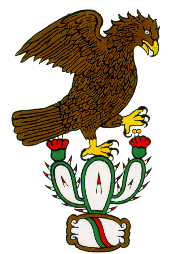
Indigenous Peoples of Mexico
The pre-Columbian
civilizations of what now is known as Mexico
are usually divided in two regions: Mesoamerica,
in reference to the cultural area in which
several complex civilizations developed before
the arrival of the Spanish in the sixteenth
century, and Aridoamerica (or simply "The
North") in reference to the arid region north of
the Tropic of Cancer in which few civilizations
developed and was mostly inhabited by nomadic or
semi-nomadic groups[citation needed]. Mesoamerica
was densely populated by diverse indigenous
ethnic groups which, although sharing common
cultural characteristics, spoke different
languages and developed unique civilizations.
One of the most influential civilizations that
developed in Mesoamerica was the Olmec
civilization, sometimes referred to as the
"Mother
Culture of Mesomaerica". The later
civilization in Teotihuacán reached its peak
around 600 AD, when the city became the sixth
largest city in the world, whose cultural and
theological systems influenced the Toltec
and Aztec
civilizations in later centuries. Evidence has
been found on the existence of multiracial
communities or neighborhoods in Teotihuacan (and
other large urban areas like Tenochtitlan).
The Maya civilization, though also influenced by
other Mesoamerican civilizations, developed a
vast cultural region in south-east Mexico and
northern Central America, while the Zapotec
and Mixtec
culture dominated the valley of Oaxaca,
and the Purepecha
in western Mexico.
The most significant
groups are the Tarahumaras,
Nahuas,
Huicholes,
Purépechas,
Mixtecos,
Zapotecas,
Otomís,
Totonacas
and Mayas.
They still form the major population group in
some regions of the country, but as in other
parts of the world, indigenous
peoples in Mexico are treated as
worth-less, second class citizens by 'pure
European' Mexicans and mixed race mestizos (like
Travellers in Ireland). High levels of migration
to the cities - where they often end up as the
cheapest of the cheap labour - and to the U.S.
has been one consequence of the loss of
traditional lands.
There are 62 indigenous groups in Mexico, each with a unique language, although certain languages have multiple dialects which may be mutually unintelligible. In 2005, the indigenous population was estimated at 12 million, some 11% or 12% of the national population. The majority of the indigenous population is concentrated in the central and south-eastern states.
 Return to Indigenous
Peoples' Literature
Return to Indigenous
Peoples' Literature
Compiled by: Glenn
Welker
ghwelker@gmx.com
This site has been accessed 10,000,000 times since February 8, 1996.