To view this page in another language, please click here:
Other Languages
Zapatista Thunder
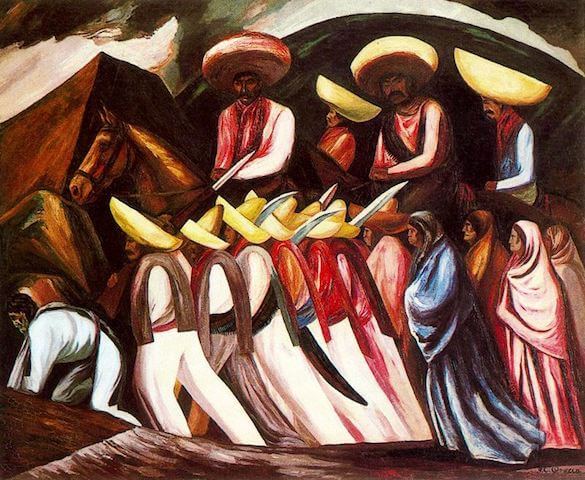
March 1994Mexico: Zapatista Thunder
by Lucy Conger
The January uprising in Chiapas has galvanized Mexican political thought and forced the country to face a fundamental issue: "For decades, the conventional wisdom about Mexico held that democratization...would threaten political stability in a land with a fearsome history of bloody uprisings. Today, democratization seems the only guarantor of stability and peace."
On January 11, 10 days after guerrillas calling themselves the Zapatista National Liberation Army (EZLN) launched bold attacks on five towns and an army barracks in the southern state of Chiapas, television newscaster Jorge Ramos fired a pointed question at a Mexican official. "Senor consul, is the government concerned that in this election year people might want to vote for an opposition party because it might bring peace instead of staying with the ruling [Institutional Revolutionary] party (PRI), that has brought war to the country?" With that single question, Ramos put the PRI's much-touted record of 65 years of social peace on the line. His question reflects the severe credibility crisis at home and abroad for the administration of President Carlos Salinas de Gortari that was unleashed in two explosive weeks of fighting by the Zapatista guerrillas. Salinas himself had achieved an image control with the press that nearly matched that enjoyed by American President Ronald Reagan in his heyday. But suddenly his grasp on events had slipped. "Before, it was as though he was a type of king, or God, who made no mistakes and all he touched ran marvelously, like a magician. Now we know that was a very partial view. We focused on the economic situation in general and lost sight of the social question," noted Salinas sympathizer Susan Kaufman Purcell, the vice president for Latin American affairs at the Americas Society. In late January a worried Salinas scurried off to an international financial community meeting in Davos, Switzerland, seeking to reassure investors. His message was that the guerrilla conflict was localized in Chiapas and that a political pact signed just before the meeting would guarantee peaceful presidential and congressional elections in August. Despite those calming words, the Zapatista army, a predominantly indigenous force several thousand strong, has moved the conflict beyond the Chiapas borders by pushing its priorities to the top of the national agenda. In their "Declaration of War," the guerrillas raised the social question by demanding jobs, housing, health, and education for Mexico's impoverished indigenous peoples, and made an unequivocal demand for honest elections this year. They have created a new imperative for democratic reforms in Mexico that will make the August presidential race the most contentious ever and holds out the possibility of ending the nearly seven decades of continuous rule by the PRI. It remains to be seen whether Mexico can stage clean elections, but what is already clear since the Chiapas uprising is that Salinas and his Institutional Revolutionary party are moving faster toward political reform than in the previous five years of his administration. The crisis exposed the lack of political sensibility among Salinas's inner circle of technocrats. Salinas initially responded with force, sending the army in to retake towns held by the Zapatistas. Within days, the army was under attack in the national and foreign press for alleged human rights violations, including bombing of civilian areas, summary executions, and torture. Ten days after the conflict broke out the Salinas administration regained its balance and began moving aggressively to recover the political initiative and press for the pacification of the conflict. A key move was the appointment of Manuel Camacho, the last remaining _politico_ in the Salinas camp, as peace commissioner. The toppling of the hard-line interior minister and the weak Chiapas interim governor and the announcement of a unilateral army cease-fire reversed the initial military response and made clear the government's intention of seeking a political solution. The rebellion, which claimed as many as 400 lives in initial fighting, brought tens of thousands of citizens out for marches calling for a truce and peace talks. Opposition politicians tried to capitalize on the popular demand for peace, and the government benefited from the outcry against violence, which helped isolate the armed movement. Within two weeks, the government and the guerrillas had accepted Bishop Samuel Ruiz of San Cristobal de las Casas, a longtime champion of the Chiapas Indians, as a peace mediator, and one month after the fighting began both sides had reached agreement about the conditions and agendas for peace talks. The new reality in Mexico was summarized in dramatic and moving terms in a letter sent to the rebel army by 280 organizations belonging to the State Indigenous and Peasant Council of Chiapas. "After a long night that appeared to have no end, it took the Zapatista thunder to clear the darkness and aspire to the future with a new light," they wrote in an endorsement of the guerrillas' demands for freedom, justice, and democracy, especially for Mexico's indigenous and peasant peoples. The changed political landscape is evident in the new political actors that have been moved into key leadership positions and are believed capable of implementing meaningful political reform. And in an apparent strategy shift, the guerrillas pledged they would "not impede" the August presidential elections, holding out the prospect that the vote could take place normally. But in the wake of the Chiapas uprising, all of Mexico is asking: "What is normal now?" CHIAPAS IS MEXICO The violent uprising stunned officials and citizens alike, but no one was surprised that the insurgency arose in Chiapas. Tucked away in the far southeastern corner of the country, Chiapas was part of Guatemala until it joined Mexico in 1824. Chiapas is Mexico's poorest state, home to 1 million impoverished Indians who eke out a spartan living as small farmers, day laborers, charcoal- makers, and artisans. The legacy of centuries of malnutrition is painfully obvious: most of the Indians are less than five feet tall. More than 30 percent of the state's 3.2 million inhabitants are illiterate, 32 percent speak only an Indian language, and 72 percent of schoolchildren do not complete first grade. Although the state produces 55 percent of Mexico's hydroelectric power, 34 percent of homes have no electricity. The indigenous are the victims of countless land disputes in which feudal land barons, known as _caciques,_ send bands of armed men to evict Indians from their lands. Violence is institutionalized through links between the _caciques_ and local officials, who typically turn a deaf ear to the land disputes and intimidate or jail priests and other advocates who defend the Indians' land struggles. "The origins of the armed movement of Chiapas are in actions that were stimulated by the government," which for decades has ignored the Indians' claims for land and justice, writes political columnist Miguel Angel Granados Chapa in Mexico City's _Reforma_ newspaper. Curiously, the highest voter support for the PRI in the 1988 election was won in this state of poverty and discrimination where, according to official election results, more than 90 percent of voters backed the ruling party. But as political analyst Alberto Aziz Nassif has noted, in Chiapas "thousands of votes [were] extracted by a fraudulent administration of elections made by PRI." Among government officials and financiers and businessmen, it has become popular to refer to the Zapatista uprising as the "Chiapas incident." While Chiapas may be physically isolated from the rest of Mexico, and living conditions may be miserable in the extreme, the state's problems now permeate national life. Many Mexicans point to the hardships of life in Chiapas as emblematic of what is wrong with Mexico's economic model, which has catapulted 11 men to billionaire status while confining 43 million Mexicans to a life of poverty. "Chiapas es Mexico" is a new slogan born of the crisis, and it is a bitter retort to the government's attempts to defend its stringent economic policies that have lowered inflation, sold off state-owned enterprises, and ended federal budget deficits while failing to stimulate robust growth, create jobs, or combat poverty. It is telling that no one in government, from President Salinas down, has questioned the legitimacy of the Zapatista army demands for jobs and social programs as well as independence, freedom, democracy, justice, and peace. PRI presidential contender Luis Donaldo Colosio, who led the government's antipoverty program before he was named the party's candidate, said that social programs have been "insufficient to eradicate the ancestral poverty" in Chiapas. The bitter conditions that fueled the Chiapas uprising exist in many other regions in Mexico and afflict indigenous groups that live in 27 of the country's 31 states, posing the threat that unrest could spread. Mexicans have taken the Chiapas crisis to heart. In 10 years of reporting in Mexico, I have never seen friends and acquaintances so shaken or moved. "It is clear to me that the [government's] economic program benefits me, but morally it is not fair that my indigenous countrymen are fighting for land," said one. Teachers have stormed out of classrooms enraged with students who refuse to admit to racism against Indians, and artists and scholars say they cannot sleep and suffer nightmares because of the uprising. "Chiapas has awakened a social conscience that was asleep because we did not see the possibility of change," says Fernanda Navarro, a philosophy professor at the Nicolaita University in Morelia, Michoacan. A DEMOCRATIC REFORM? With pressure from the Zapatistas bearing down, two important steps were taken in late January that could make the presidential election credible and prevent bitter postelection disputes that might turn violent. On January 27 Mexico's three leading political parties and five of six small parties signed a "Pact for Peace, Democracy, and Justice," saying that honest elections acceptable to civil society and political parties are "a necessary condition" for establishing a "just and durable peace." To gain credibility for the elections, the eight parties pledged to adopt measures that would promote clean elections and "establish mechanisms that give full reliability to the voter registration roll." Ever since the tainted 1988 presidential election, which millions of Mexicans believe was won by opposition leader Cuauhtemoc Cardenas, the voter rolls have been the focus of bitter controversy. Leaders of the conservative National Action party (PAN) and the liberal Democratic Revolution party (PRD) charge the voter rolls are larded with names of dead people and riddled with inaccuracies that prevent eligible voters from voting. Election credibility will be enhanced by the appointment in January of Jorge Carpizo, a respected jurist, as interior minister and final arbiter of the balloting. The pact also calls on the Zapatistas to put down their arms and enter public life as a political force. Peace Commissioner Manuel Camacho pressed this issue on the guerrillas by calling the EZLN a "political force in formation" in a statement that outlined his plan for peace negotiations. The pact recognizes the political parties as the representative force on the question of democratic reform, and aims to keep the issue of national democratization out of the peace talks. The agreement demonstrates movement toward political reform, a topic that was taboo as recently as a few months ago. The significance of the pact lies in its intention to negotiate details and its acceptance of the principle of promoting a legal reform that would set out stringent election procedures to eliminate the present system of PRI control of election review boards. The reform debate would also raise the sensitive issue of accepting international election observers. Finally, the pact recognizes the authenticity of opposition candidate Cuauhtemoc Cardenas and the PRD. Through the pact, the government and the PRI "have accepted that you can't have a clean election without a fuss if Cardenas is not on board" and this grants Cardenas a kind of veto power over reform measures, says political scientist Jorge G. Castaneda. But others caution against a premature celebration of the end of the state-party regime. They point to the desire of Salinas and his group to retain control of the political system and emphasize the key elements of political reform remain undefined. "I prefer to see that which I do not desire: the regime does not want to make true changes," writes historian Enrique Krauze. Another important step toward democratization received a new impetus from pressures created by the guerrilla uprising. On January 26, PRI candidate Colosio pledged that he will support clean elections and a program of 20 democratic reforms that are being proposed to all presidential candidates by a nonpartisan movement led by intellectuals, politicians, artists, and citizen activists. Colosio's endorsement of the civil society document, "20 Pledges for Democracy," is significant because the reforms would weaken the PRI's hold on power, reduce presidential powers, and pave the way for a system of checks and balances by creating greater independence in the legislative and judicial branches of government. A POSTMODERN GUERRILLA The Zapatista National Liberation Army is unlike any other Latin American guerrilla movement, and in its short public life has shown a flexibility and moderation previously unknown in the hemisphere. The Zapatistas distinguished their movement with their ready willingness to engage in peace talks. Only one week after taking up arms, the guerrilla leadership responded favorably to government offers to hold a dialogue to debate the EZLN agenda of social and economic demands, a cease-fire, and political participation for indigenous and other citizens. Three weeks after their initial attacks, the Zapatistas announced a major strategy shift in a communique that reversed their initial demands for the overthrow of Salinas and the army and pledged they "will not impede the elections of 1994." The Zapatistas launched their uprising in unusual times, historian Lorenzo Meyer points out. "The EZLN [rebellion] is the first postmodern rebellion of Latin America. The first that is born not only in postcommunism but also, and this is important, [born] in post-anticommunism," Meyer wrote in the newspaper _Excelsior._ In this context, the Zapatistas explicitly renounced the standard leftist goals of leading revolution and taking power. "There are and there will be other revolutionary organizations. We do not intend to be the one, sole, and true historic vanguard," said an EZLN communique published January 25. This sharply unorthodox approach reflects a keen reading of the political climate by the Zapatistas, who can maximize their impact by seizing the precise moment for striking--the election year--and have now chosen to join the growing clamor for honest elections and democratization, analysts say. The "public face" of the EZLN is SubComandante Marcos, a tall man who wears a ski mask that reveals only his green eyes and part of his prominent nose. The subcomandante, who spoke from behind his mask to a dazed crowd of residents and tourists in the plaza of San Cristobal de las Casas on New Year's Day, has captured the popular imagination through the bold moves of the Zapatistas and through a dozen communiques that reveal a direct, powerful writing style and a sense of humor heretofore concealed by most Latin American guerrillas. In a sharply worded communique that warned the army it would have to kill every Zapatista to eradicate the guerrilla command, the insurgent subcomandante fired a potshot at Mexican insensitivity to the indigenous: "A question: Will all of this serve so that at least the 'Mexicans' learn to say 'Chiapas' instead of 'Chapas' and say 'Tzeltales' instead of 'Setsales'?" Public response to the guerrillas might be considered postmodern also. The Zapatistas have rekindled the romanticism classically associated with leftist movements, but have also stirred deep fears of social unrest and sparked massive protests renouncing the use of violence. Troubling questions hover over the movement about the source of the rebels' money and weapons, and the answers could shift public sentiment away from the Zapatistas. CONTINUITY AS LIABILITY The guerrilla conflict eclipsed the presidential campaign, which was officially kicked off in January. The Zapatista social and political demands challenge all candidates to revamp their rhetoric and platforms. PRI contender Luis Donaldo Colosio is under the most pressure to reformulate his program. Colosio was chosen as PRI candidate by Salinas because he best assured the continuity of the Salinas economic reforms. But in the redefined Mexico, continuity has become a political liability. Doubts about the economic model that Colosio would carry forward have deepened since Chiapas. The Salinas reforms that privatized public companies, removed barriers to foreign competition, and created federal budget surpluses also left nearly half of all Mexicans living in poverty or extreme poverty. The Solidaridad program of public works and targeted food subsidies, which was run by Colosio, was created to alleviate the poverty spread by the modernizing liberal reforms. Solidaridad projects were to be a pillar of the PRI campaign. But once the spotlight of national attention was trained on the extreme poverty of Chiapas-- which has received one of the highest levels of Solidarity funds-- the flaws of the antipoverty program became apparent. The dusty Tzotzil Indian town of Chenalho, Chiapas, is a case in point. In the past two years, Solidaridad came to Chenalho, financed construction of a meeting hall for farmers, and built a public bathhouse that smells from two blocks away. But no jobs were created, and the local priest says farmers lack production credits. Many of the Tzotziles of Chenalho scratch out a bare existence growing corn and coffee on the steep hillsides above town; many others are forced to emigrate to the adjoining states of Tabasco and Oaxaca to get work in construction or other jobs. "They stay away for two or three months and come back when they've earned some money and go away again when they've spent it," Felipe Abarca Villafuerte, a primary school teacher, told foreign reporters. The Colosio campaign got off to a lackluster start. On February 1, he made a good effort to drape himself in the mantle of justice. In a campaign speech at Ananecuilco, the birthplace of revolutionary hero Emiliano Zapata, Colosio intoned, "The claim, beliefs, and yearnings [of Zapata] are still in force; his call demands a reply. The cry of 'Land and Liberty' is still today a demand for justice, it is a condition for peace, for stability of the country, and for prevailing over poverty." The candidate went on to promise a new strategy of governing, but offered no compelling details. The government's credibility crisis offers Colosio an opportunity to strike out in new directions and create his own identity and platform independent of Salinas. If he cannot meet the challenge, his campaign may languish. The presidential contest could face another earthquake before the final deadline in July for registration of candidates. The appointment of former Colosio rival Manuel Camacho as peace commissioner has given him national prominence and popularity, and has fueled widespread speculation that Camacho will launch himself as a presidential contender. The former mayor of Mexico City, Camacho was so bitterly disappointed when he lost the PRI presidential nomination to Colosio that he staged an unorthodox public protest and hinted he would leave government. Back in the limelight and active in his preferred role as a protagonist, he stands to win great popularity as the man who may restore political stability. As peace talks began in February, Camacho remained a wild card in the election. He still nurtures presidential ambitions, but the scenarios for his candidacy are highly problematic, and Salinas himself spoke out to re-endorse the Colosio candidacy and quash the rumors that Camacho might replace Colosio as PRI's presidential choice. Even if he ran on another party's ticket, a Camacho candidacy would divide the PRI at the very least. An important motive for Salinas's choice of Colosio was the need to maintain unity in the PRI. Paradoxically, Camacho's rehabilitation as peace commissioner has re-ignited his followers and stirred up one of the most severe divisions the party has faced. The leading opposition parties enter the election fray with handicaps. The Democratic Revolution party is still struggling to unify factions that range from socialists to PRI defectors, but its internal divisions are not likely to detract votes from its candidate, Cuauhtemoc Cardenas, who led the strongest challenge ever against PRI in the jiggered 1988 election. The National Action party has chosen as candidate Diego Fernandez de Cevallos, a man who lacks a popular following, and it lost respected independent- minded leaders last year in an internal dispute over the party's cooperation with Salinas's policies. Both parties must compete against the awesome PRI behemoth with its overpowering economic resources and nationwide election machine. A deeper problem for all the parties is the issue of representativity at a time when Mexicans increasingly prefer to affiliate with nonpartisan special interest groups--and when burgeoning civil society has seized the initiative on many pressing issues such as government accountability and human rights. The strongest threat to Colosio is Cardenas, who drew 31 percent of the vote in 1988, according to official results. Cardenas has tirelessly stumped the country for the past six years, and is expected to make a strong showing once again. It would take exceptional circumstances to bring about a Cardenas victory, but exceptional circumstances are closer at hand than at almost any time in PRI history. Cardenas's presidential bid could be boosted by fractures in the PRI, resentment against the party's perpetual rule, continuing economic hardships, unexpected fallout from the Zapatista presence, and a direct appeal to a broad constituency, including small political parties and nonpartisan civic groups. THE NEW POLITICAL PLAYERS As in other countries, new political forces are emerging in Mexico that will be important players in the election. The struggle to forge alliances across parties and with citizen groups is central to the country's political reorganization. The discipline of corporate groups and straight party voting are crumbling as part of the shift toward democracy. The PRI still counts thousands of labor and peasant organizations among its corporatist affiliates, but the 1988 election proved that their loyalty at the ballot box is questionable. Cardenas has already lined up the backing of right- wing Foro Democratico Nacional, a breakaway from the National Action party, and several small socialist parties. Last July the Democratic Revolution party endorsed a Cardenas initiative to reserve up to 50 percent of its federal and state candidacies for independents drawn from popular organizations, advocacy groups, and prominent independent people respected for their leadership in promoting democratic reforms. On February 5, below the imposing arches of the Monument to the Revolution in Mexico City, Cardenas announced the creation of the National Democratic Alliance (ADN), a pluralistic coalition that includes parties ranging across the political spectrum and scores of local civic and labor organizations, and the Citizens Movement for Democracy, a national coalition of 150 urban community associations, peasant leagues, and ecology and human rights groups. In its "Charter for Democratic Change," the ADN sets as its goal an end to the "corporatist and authoritarian system" and the election of a pluralist Congress that would draft a new constitution and promote an equitable social policy; these would be the pillars of a transition to democracy, says ADN organizer Joel Ortega. The Alliance is an open movement aimed principally at uniting civic associations and advocacy groups that can organize a massive popular campaign to monitor the presidential election and protest election fraud. Skepticism about the possibility of clean elections runs deep and wide. A recent opinion poll showed that 71 percent of respondents expect the elections, which absent reforms will be supervised by PRI-controlled agencies, to be dirty. Consequently, citizen mobilization for honest elections could be the decisive factor in setting up a credible vote and dampening protest over the outcome. The validity of the election will depend heavily on "the influential group of analysts and national and foreign citizen groups that will monitor the process," writes Carlos Ramirez, senior political columnist at Mexico City's _El_Financiero_ newspaper. The Zapatista army will also put pressure on the elections, kindling the threat of electoral unrest if the official vote count is cast in doubt. The Zapatista movement has breathed new life into the burgeoning civil society by giving an urgency to the insistent but until now little-heard popular demands for fair elections, government accountability, and citizen participation in a political system dominated by presidential power and the PRI. But the guerrilla uprising creates new imperatives if the community and farmer associations, urban groups, and special interest advocates that make up civil society are to retain credibility with the majority of Mexicans who are poor. "Civil society now has the word, but its agenda [had been] minimal and exclusively aimed at the transition to democracy. Now, civil society must take on simultaneously the struggle for justice, and for democracy," says Miguel Alvarez, a member of the Citizens Movement for Democracy. THE NOT SO ROSY ECONOMY Complicating the political panorama for this year is the dull economic outlook. The high expectations that Salinas stirred up in selling the North American Free Trade Agreement (
nafta ), which went into effect January 1, could prove elusive if investors shy away from a troubled Mexico. Growth is expected to reach 3 percent--at most 3.5 percent--this year, an inadequate level for Mexico, where the estimated 2.2 percent population growth rate absorbs most economic expansion, and where UN agencies report that annual growth of 6.7 percent is required to create enough jobs to employ the growing labor force. NAFTA was a leading motive for the Chiapas uprising, and was denounced resoundingly by the Zapatistas for job losses it is expected to cause among Mexican farmers likely to be displaced by imports of cheap United States corn. In the short run, NAFTA's greater opening to foreign competition could drive some Mexican industries out of business. Unemployment has increased in the past two years, and more Mexicans are expected to lose their jobs this year, swelling the informal economy that some analysts say employs up to 25 percent of working Mexicans. The Salinas opening has made Mexico highly dependent on foreign investment to pay for a trade deficit that is estimated to reach $18 billion in 1994. As in recent years, the stock market is expected to turn in a positive performance during the year, but as the Chiapas crisis painfully shows, growth in the financial sector does not filter down to the needy. Now the government is speeding up social spending and some say may slip into a deficit. Months before the uprising, Salinas had pledged to lighten the austerity burden imposed on voters by the liberal economic reform. The anti-inflation program for 1994 includes measures that would reduce taxes and fuel costs for consumers and allow for real increases in certain wage categories. Discontent among middle- class professionals who see no prospect for economic advancement is rampant, and they could become an important anti-PRI constituency if the economy remains weak. OF MASKED MEN AND MASKED TRUTHS Mexico has a rich tradition of masked men leading popular causes. Recently, SuperBarrio, a masked maverick who dresses like the popular _lucha_libre_ wrestlers, was born out of the ashes of the 1985 Mexico City earthquake. He defends the homeless in their fight for housing aid and stands at the side of inner city renters battling eviction. SubComandante Marcos now joins the gallery of masked would-be reformers. His mask has become controversial as peace negotiator Camacho has demanded that Marcos bare his face at the peace talks. Marcos replied fiercely to the demand that he take off his mask. "Why such a fuss over the ski mask? Is Mexican political culture not the 'culture of the veiled?,'" he asked, alluding to the traditional secrecy that shrouds the naming of PRI presidential candidates. The subcomandante issued a challenge: "I am willing to take off my ski mask if Mexican society will take off its mask" and reexamine its images of "modernity" to reconcile the third world that is Chiapas with Salinas's claims that Mexico is entering the first world. The subcomandante may remain masked, but the movement that he leads is unmasking painful truths about Mexico. "The rebellion uncovered the degree of simulation and lies in which we live," exposing racism and the impossibility of "organizing a modernization program against the people or [based on] their ignorance," writes political commentator Jose Agustin Ortiz Pinchetti in _La_Jornada_ newspaper. For decades, the state-party system dominated by the PRI has been politely called "democracia a la mexicana," a euphemism for a pluralistic political charade in which the PRI holds nearly all the cards. As these and other masks come off in Mexico, a new possibility comes into view: honest and competitive elections that could create a pluralistic democracy. The Chiapas crisis demonstrates an overwhelming popular rejection of violence and potential resilience on both sides of the conflict. Under the Salinas administration's technocrats, political institutions may be creaking but they are not yet brittle. Salinas again adopted bold moves characteristic of his leadership and pushed for a peaceful solution to the conflict. The Zapatista guerrillas made agile responses to proposals for negotiations, and recognized that meeting their demands for justice will take time. But the deadline for clean elections is fixed. For decades, the conventional wisdom about Mexico held that democratization of the state-party regime would threaten political stability in a land with a fearsome history of bloody uprisings. Today, democratization seems the only guarantor of stability and peace. Lucy Conger, Mexico correspondent for Institutional Investor magazine and Jornaldo do Brasil newspaper, has reported on Mexican politics and economics for the past 10 years. The author thanks Jornal do Brasil for granting permission to include material published in the newspaper.
 Return to Indigenous Peoples' Literature
Compiled by: Glenn Welker
ghwelker@gmx.com
This site has been accessed 10,000,000 times since February 8, 1996.