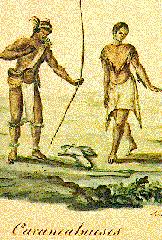
"Carancahueses," Karankawa
Indians of the Gulf Coast.
The Karankawa Indians were a group of Indian Tribes that lived along the Texas Coast. Ironically, by the year 1860, on the eve of the American Civil War, they had been completely exterminated. There are lagoons, or bays, spread out along the Texas Coast where the Karankawa made their camp sites; mainly because the bottoms were mostly smooth and the water was shallow. These waters enabled them to go out into the pools and in the clear, slowly ebbing water taking the fish and oysters they desired.
The first of these Bays is Galveston with its subdivisions, East Bay, Turtle Bay, Trinity Bay, West Bay, Dollar Bay, Clear Bay and Oyster Bay. To the Southwest is Matagorda Bay which has parts known as Oyster Lake, Trespalacios Bay, Carancahua Bay, Kellers Bay, Cox Bay, Chocolate Bay, and Lavaca Bay. Next is Espiritu Santo Bay, with its northern extension, San Antonio Bay. Fourth is Aransas Bay, which has parts know as St. Charles Bay, Copano Bay, Mission Bay and Fuerte Bay. Fifth is Corpus Christi Bay with its extension, Nueces Bay. The Last Bay is Laguna de la Madre.

THE
KARANKAWAS
inhabited the Gulf coast from Galveston down to Corpus
Christi, mainly coastal prairie grassland, cut by streams and
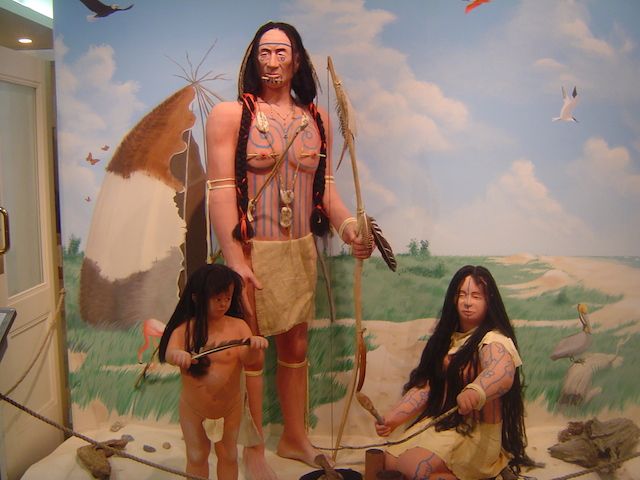
occasional forests. Cabeza de Vaca described the Karankawas as
tall (6
ft common), well-built, muscular, the men stark naked, with
lower lip
and nipples pierced, covered in alligator grease (against
mosquitos),
happy and generous, with amazing physical prowess. "... they go
naked
in the most burning sun ....- in winter they go out in early
dawn to
take a bath ... breaking the ice with their body...". With cedar
bow
and arrow: "... aimed at a bear in the top of a tree ... the
arrow went
through the body and was propelled 40 to 50 yards beyond ...";
"though
impelled nearly 200 yards, the arrows were driven to the feather
in the
alluvial bank."
From the gulf waters - using dugout canoes - they took oysters,
clams,
scallops, mollusks, turtles, fish, porpoises, alligators and
underwater
plants. Deer were hunted, occasional buffalo, bear, peccary,
smaller
mammals, ducks. Berries, nuts, seeds and other plants were
gathered. No
foods were continously plentiful, when the harvest was good they
gorged
at repletion. "unique in their gluttony .... they eat locusts,
lice,
even human flesh ... raw meat, bear's fat .... passion for
spoiled food
...". In spring they might subsist exclusively on oysters, "then
for a
month they ate blackberries".
Fires for cooking were built in willow pole shelters. Trade with
the
inland tribes: conch shells in exchange for skins, red ocher,
flint,
and deer hair (for tassels).
The now-extinct Karankawa Indians played an important role in the early history of Texas. The name Karankawa became the accepted designation for several groups or bands of coastal people who shared a common language and culture. Those bands, identified in early historic times, included the Capoques (Coaques, Cocos), Kohanis, Kopanes (Copanes), and Karankawa proper (Carancaquacas). They inhabited the Gulf Coast of Texas from Galveston Bay southwestward to Corpus Christi Bay. All spoke a little-known language called Karankawa, and only about 100 words of that language have been preserved. The significance of the name Karankawa has not been definitely established, although it is generally believed to mean "dog-lovers" or "dog-raisers." That translation seems plausible, since the Karankawas reportedly kept dogs that were described as a fox-like or coyote-like breed. The Karankawas were poorly equipped, nomadic people who migrated seasonally between the barrier islands and the mainland. Their movements were dictated primarily by the availability of food and secondarily by climate. They obtained food by a combination of hunting, fishing, and gathering. Fish, shellfish, and turtles were staples of the Karankawa diet, but a wide variety of animals and plants contributed to their sustenance.
The first of the Europeans to encounter the Karankawa
were
the Spaniards. A group led by Panfilo de Narvaez left Spain in
1527,
sent by Charles V to conquer and settle Florida. He reached the
Florida
west Coast near Tampa Bay in April 1528. Narvaez split his
forces into
two groups, one by sea and the other by land to Appalache. Alvar
Nunez
Cabeza de Vaca was treasurer of the expedition, which was the
inland
party and who disagreed with the split. Narvaez marched inland
where
his forces suffered from Indian attacks and lack of food. When
the land
force did not appear on schedule, the ships sailed away back to
Spain,
leaving Narvaez and Cabeza de Vaca stranded. The expedition
built crude
boats to carry them to Panuco in Mexico. The year was still 1528
when
they set out to Mexico with about 100 men. They met with rough
water
where Narvaez was washed out to sea in a storm near the south
Texas
Coast. The boats ran aground on the island of Malhado near the
present
day Galveston, Texas, with about 80 survivors. The Spaniards
began on
the Texas Coast with a cold winter, raw enough to kill all but
fifteen
men. Those who survived turned to and devoured the corpses of
their
dead. The accounts of what happen rest with Cabeza de Vaca,
simply
because he lived to tell the story. He resided on Malhado for a
time,
then escaped to the main land, where hewas a trader and a slave
of the
Karankawa.
The problem he had with the Karankawa is they would alternately love and despise him, depending on their mood. In February 1529 the Indians, probably the Coco tribe, which had Cabeza de Vaca in tow, moved inland from Malhado Island. The drinking water was bad, there was little fire wood, and the mosquitoes were in heavy concentrations,but the Oysters were abounded in the bays. Cabeza de Vaca's life was made miserable due to the fact he was forced to work hard pulling eatable roots from the water and Canes where they grew. His fingers became tender and would bleed. Cabeza de Vaca said that these were the cruelest Indians he met. It was here he fell ill. When he regained his strength he escaped to the Charruco tribe. This Tribe he said was much kinder than the Coco. He reported that although theCoco was cruel to him, they were furious at the Spaniards for eating human flesh the winter of 1528 and he said he saw no Cannibalism in the Natives. Cabeza de Vaca noted their love for their children. When a child died, the entire village would weep for a hold year, three times each day, then wash and purify themselves in charcoal paint. In October 1534 Cabeza de Vaca escaped from the Karankawa, accompanied by Andres Dorantes de Carranza, Alonso de Castillo Maldanado, and the Negro, Estevanico. The group slowly made there way west to Mexico. For over a hundred and fifty years the Karankawa were left alone, until 1685 when Rene Robert Cavelier, Sieur de La Salle landed in Karankawa Country.

The Karankawa had a strong love and affection for their children. When a child died the entire Tribe mourned for a year, at dawn, noon, and sunset they performed their mourning rite. If a Son or Brother died the family would mourn for a month, and remain in seclusion, refusing to get food. Other Tribe members would bring eatables to the family. This practice could have been carried to the extremes if a member in every family would have died. There is little known about the Karankawa Religious beliefs except for their festivals and Mitote, a ceremony performed after a great victory in battle. The festivals were performed during a full moon, after a successful hunting or fishing expedition in a large tent with a burning fire in the middle.
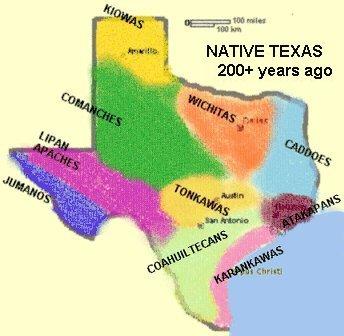
The Karankawa
lived along the "coastal bend" of Texas. Look at this map first.
The
coastal bend starts at the west end of Galveston Island and
extends
southwest down to Corpus Christi. It has several large, shallow
bays
that reach miles inland and long narrow barrier islands that
protect
lagoons between the islands and the mainland. (You better look
up what
a barrier island is and what a lagoon is if you don't know. Or,
ask
your teacher. That will make your teacher glad that you asked
such a
good question ;-) The Karankawa lived around these bays and
along the
lagoons, mostly in the winter. These bays and lagoons supported
a rich
variety of wildlife. There were many kinds of fish and oysters
in the
salt water and brackish water. Most of these bays have large
rivers
that empty into them, such as the Colorado and the Guadalupe.
There are
also many large creeks in the coastal bend along with swamps and
bayous
and wetlands. There are many kinds of ducks and waterfowl in
this
environment. Alligators and large turtles are also found in
wetlands
and swamps and are good to eat. Just inland there are deer and
turkey
along with rabbits. In the spring and early summer there are
blackberries and many other kinds of plants and roots to eat.
The
Karankawa Indians
by R. E. Moore, www.TexasIndians.com
Handbook
of
Texas Online: Karankawa Indians
The
History of
San
Leon: Karankawa Indians
(Best resources on the Internet)
Karankawa
Indian
Campsite
The
Karankawa
Culture
and History
 Return to
Indigenous Peoples' Literature
Return to
Indigenous Peoples' Literature
Compiled by: Glenn Welker
This site has been accessed over 10,000,000 times since
February 8,
1996.