To view this page in another language, please click here:
Other Languages
Sixtenth Century Indigenous Jalisco
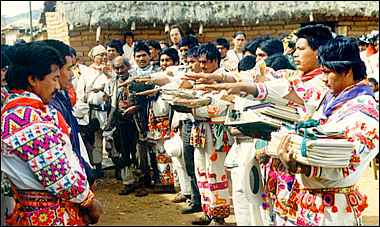
Jalisco is La Madre Patria (the Mother Country) for millions of Mexican Americans. Given this fact, it makes sense that many sons and daughters of Jalisco are curious about the cultural and linguistic roots of their indigenous ancestors. The modern state of Jalisco consists of 31,152 square miles (80,684 square kilometers) located in the west central portion of the Mexican Republic. However, the Jalisco of colonial Mexico was not an individual political entity but part of the Spanish province of Nueva Galicia, which embraced some 180,000 kilometers ranging from the Pacific Ocean to the foothills of the Sierra Madre Occidental. Besides the present-day state of Jalisco, Nueva Galicia also included the states of Aguascalientes, Zacatecas, Nayarit, and the northwest corner of San Luis Potosi. Across this broad range of territory, a wide array of indigenous groups lived before 1522 (the first year of contact with Spanish explorers). Domingo Lazaro de Arregui, in his Descripcián de la Nueva Galicia - published in 1621 - wrote that 72 languages were spoken in the Spanish colonial province of Nueva Galicia. But, according to the author Eric van Young, "the extensive and deep-running mestizaje of the area has meant that at any time much beyond the close of the colonial period the history of the native peoples has been progressively interwoven with (or submerged in) that of non-native groups."
As the Spaniards and their Indian allies from the south made their way into Nueva Galicia early in the Sixteenth Century, they encountered large numbers of nomadic Chichimeca Indians. Philip Wayne Powell - whose Soldiers, Indians, and Silver: North America's First Frontier War is the definitive source of information relating to the Chichimeca Indians - referred to Chichimeca as "an all-inclusive epithet" that had "a spiteful connotation." The Spaniards borrowed this designation from their Aztec allies and started to refer to the large stretch Chichimeca territory as La Gran Chichimeca.
Afredo Moreno Gonzalez, in his recent book Santa Maria de Los Lagos, explains that the word Chichimeca has been subject to various interpretations over the years. Some of these suggestions included "linaje de perros" (of dog lineage), "perros altaneros" (arrogant dogs), or "chupadores de sangre" (blood-suckers). In any case, it was apparent that the Mexican Indians of the south did not hold their northern counterparts in high regard. However, in time, they learned to both fear and respect many of these Indians as brave and courageous defenders of their ancestral homelands.
Unfortunately, the widespread displacement that took place starting in 1529 prevents us from obtaining a clear picture of the indigenous Jalisco that existed in pre-Hispanic times. Four primary factors influenced the post-contact indigenous distribution of Jalisco and its evolution into a Spanish colonial province. The first factor was the 1529-30 campaign of Nu̱o Beltran de Guzman. In The North Frontier of New Spain, Peter Gerhard wrote that "Guzman, with a large force of Spaniards, Mexican allies, and Tarascan slaves, went through here in a rapid and brutal campaign lasting from February to June 1530 Guzman's strategy was to terrorize the natives with often unprovoked killing, torture, and enslavement."
Once Guzman had consolidated his conquests, he ordered all of the conquered Indians of Jalisco to be distributed among Spanish encomiendas. The individual receiving the encomienda, known as the encomendero, received free labor and tribute from the Indians, in return for which the subjects were commended to the encomendero's care. It was the duty of the encomendero to Christianize, educate and feed the natives under their care. However, as might be expected, such institutions were prone to misuse and, as a result, some Indians were reduced to slave labor.Although Guzman was arrested and imprisoned in 1536, his reign of terror had set into motion institutions that led to the widespread displacement of the indigenous people of Jalisco.
The second factor was the Mixtan Rebellion of 1541-1542. This indigenous uprising was a desperate attempt by the Cazcanes Indians to drive the Spaniards out of Nueva Galicia. In response to the desperate situation, Viceroy Mendoza assembled a force of 450 Spaniards and some 30,000 Aztec and Tlaxcalan supporting troops. In a series of short sieges and assaults, Mendoza gradually suffocated the uprising. The aftermath of this defeat, according to Peter Gerhard, led to thousands of deaths. In addition, he writes, "thousands were driven off in chains to the mines, and many of the survivors (mostly women and children) were transported from their homelands to work on Spanish farms and haciendas."
The third factor influencing Jalisco's evolution was the complex set of relationships that the Spaniards enjoyed with their Indian allies. As the frontier moved outward from the center, the military would seek to form alliances with friendly Indian groups. Then, in 1550, the Chichimeca War had began. This guerrilla war, which continued until the last decade of the century, was primarily fought by Chichimeca Indians defending their lands in Zacatecas, Guanajuato, Aguascalientes, and northern Jalisco.
The Chichimeca conflict forced the Spaniards to rely heavily upon their Christian Indian allies. The result of this dependence upon indigenous allies as soldados (soldiers) and pobladores (settlers) led to enormous and wide-ranging migration and resettlement patterns that would transform the geographic nature of the indigenous peoples of Nueva Galicia. In describing this phenomenon, Mr. Powell noted that the "Indians formed the bulk of the fighting forces against the Chichimeca warriors As fighters, as burden bearers, as interpreters, as scouts, as emissaries, the pacified natives of New Spain played significant and often indispensable roles in subjugating and civilizing the Chichimeca country."
By the middle of the Sixteenth Century, the Tarascans, Aztecs, Cholultecans, Otomis, Tlaxcalans, and the Cazcanes had all joined forces with the Spanish military. By the time the Chichimeca War had begun, the Tarascans and Otomies, in particular, had already developed "considerable experience in warfare alongside the Spaniards." As a result, explains Mr. Powell, "they were the first important auxiliaries employed for entradas against the Chichimecas."
The employment of Tarascans, Mexicans, and Tlaxcalans for the purpose of "defensive colonization" also encouraged a gradual assimilation of the Chichimecas. In the 1590s Nahuatl-speaking colonists from Tlaxcala and the Valley of Mexico settled in some parts of Jalisco to serve, as Mr. Gerhard writes, "as a frontier militia and a civilizing influence." As the Indians of Jalisco made peace and settled down to work for Spanish employers, they were absorbed into the more dominant Indian groups that had come from the south. By the early Seventeenth Century, writes Mr. Powell, most of the Chichimeca Indians had disappeared as distinguishable cultural entities.
The fourth cause of depopulation and displacement of the Jalisco Indians was contagious disease. The physical isolation of the Indians in the Americas is the primary reason for which disease caused such havoc with the Native American populations. This physical isolation resulted in a natural quarantine from the rest of the planet and from a wide assortment of communicable diseases. When smallpox first ravaged through Mexico in 1520, no Indian had immunity to the disease.
During the first century of the conquest, the Mexican Indians suffered through 19 major epidemics. They were exposed to smallpox, chicken pox, diphtheria, influenza, scarlet fever, measles, typhoid, mumps, influenza, and cocoliztli (a hemorrhagic disease). Peter Gerhard has estimated the total native population of Nueva Galicia in 1520 at 855,000 persons. However, in the next two decades, the populous coastal region north of Banderas Bay witnessed the greatest population decline. "The unusually brutal conquest," writes Mr. Gerhard, "was swiftly followed by famine, further violence and dislocation, and epidemic disease."
By the late 1530s, the population of the Pacific coastal plain and foothills from Acaponeta to Puficacián had declined by more than half. Subsequently, Indians from the highland areas were transported to work in the cacao plantations. When their numbers declined, the Spaniards turned to African slaves. By 1560, Mr. Gerhard wrote, the 320,000 indigenous people who occupied the entire tierra caliente in 1520 had dropped to a mere 20,000. A plague in 1545-1548 is believed to have killed off more than half of the surviving Indians of the highland regions. By 1550, it is believed that there were an estimated 220,000 Indians in all of Nueva Galicia.
The author Jose Ramirez Flores, in his work, Lenguas Indigenas de Jalisco, has gone to great lengths in reconstructing the linguistic map of the Jalisco of the Sixteenth and Seventeenth Centuries. It must be remembered that, although Jalisco first came under Spanish control in the 1520s, certain sections of the state remained isolated and under Amerindian control until late in the Sixteenth Century. The diversity of Jalisco's early indigenous population can be understood more clearly by exploring individual tribes or regions of the state. The following paragraphs are designed to provide the reader with some basic knowledge of several of the indigenous groups of Jalisco:
The Cazcanes. The Cazcanes (Caxcanes) lived in the northern section of the state. They were a partly nomadic people, whose principal religious and population centers were at Teul, Tlaltenango, Juchipila, and Teocaltiche. According to Se̱or Flores, the languages of the Caxcanes Indians were widely spoken in the northcentral portion of Jalisco along the "Three-Fingers Border Zone" with Zacatecas. It is believed that the Caxcanes language was spoken at Teocaltiche, Ameca, Huejocar, and across the border in Nochistlan, Zacatecas.
According to Mr. Powell, the Caxcanes were "the heart and the center of the Indian rebellion in 1541 and 1542." After the Mixtán Rebellion, the Cazcanes became allies of the Spaniards. For this reason, they suffered attacks by the Zacatecas and Guachichiles during the Chichimeca War. A a cultural group, the Caxcanes ceased to exist during the Nineteenth Century.
Cocas. The Coca Indians inhabited portions of central Jalisco, in the vicinity of Guadalajara and Lake Chapala. When the Spaniards first entered this area, the Coca Indians, guided by their leader Tzitlali, moved away to a small valley surrounded by high mountains, a place they named "Cocolan." Because the Cocas were peaceful people, the Spaniards, for the most part, left them alone. Jose Ramirez Flores lists Cuyutlan, San Marcos, Tlajomulco, Toluquilla and Poncitlan as towns in which the Coca language was spoken.
The Coras. The Coras inhabited what is most of present-day Nayarit as well as the northwestern fringes of Jalisco. The word "mariachi" is believed to have originated in their language. Today, the Coras, numbering up to 15,000 people, continue to survive, primarily in Nayarit and Jalisco. The Cora Indians have been studied by several historians and archaeologists. One of the most interesting works about the Cora is Catherine Palmer Finerty's In a Village Far From Home: My Life Among the Cora Indians of the Sierra Madre (Tucson: University of Arizona Press, 2000).
Cuyutecos. The Cuyutecos - speaking the Nahua language of the Aztecs - settled in southwestern Jalisco, inhabiting Atenquillo, Talpa, Mascota, Mixtlan, Atengo, and Tecolotlan. The population of this area - largely depleted by the epidemics of the Sixteenth Century - was partially repopulated by Spaniards and Indian settlers from Guadalajara and other parts of Mexico. It is believed the Cuyuteco language may have been a late introduction into Jalisco. Other Nahua languages were spoken in such southern Jalisco towns as Tuxpan and Zapotlan.
Guachichiles. The Guachichiles, of all the Chichimeca Indians, occupied the most extensive territory. The Guachichile Indians - so well known for their fierce resistance towards the Spaniards in the Chichimeca War (1550-1590) - inhabited the areas near Lagos de Moreno, Arandas, Ayo el Chico, and Tepatitlan in the Los Altos region of northeastern Jalisco. Considered both warlike and brave, the Guachichiles also roamed through a large section of the present-day state of Zacatecas.
The name of "Guachichile" that the Mexicans gave them meant "heads painted of red," a reference to the red dye that they used to pain their bodies, faces and hair. Although the main home of the Guachichile Indians lay in Zacatecas, they had a significant representation in the Los Altos area of Jalisco. After the end of the Chichimeca War, the Guachichiles were very quickly assimilated and Christianized and no longer exist as a distinguishable cultural entity.
Huicholes. Some historians believe that the Huichol Indians are descended from the nomadic Guachichiles, having moved westward and settled down to an agrarian lifestyle, inhabited a small area in northwestern Jalisco, adjacent to the border with Nayarit. The Huicholes, seeking to avoid confrontation with the Spaniards, became very isolated and thus we able to survive as a people and a culture.
The isolation of the Huicholes ‰EUR" now occupying parts of northwestern Jalisco and Nayarit ‰EUR" has served them well for their aboriginal culture has survived with relatively few major modifications since the period of first contact with Western culture. Even today, the Huichol Indians of Jalisco and Nayarit currently inhabit an isolated region of the Sierra Madre Occidental. Their language was spoken in the northern stretches of the Three-Fingers Region of Northern Jalisco, in particular Huejuquilla, Tuxpan and Colotlan.
The survival of the Huichol has intrigued historians and archaeologists alike. The art, history, culture, language and religion of the Huichol have been the subject of at least a dozen books. Carl Lumholtz, in Symbolism of the Huichol Indians: A Nation of Shamans (Oakland, California: B.I. Finson, 1988), made observations about the religion of the Huichol. Stacy B. Schaefer and Peter T. Furst edited People of the Peyote: Huichol Indian History, Religion and Survival (Albuquerque: University of New Mexico Press, 1996), discussed the history, culture and language of these fascinating people in great detail.
Otomies. The Otomies were a Chichimeca nation primarily occupying Queretaro and Jilotepec. However, early on, the Otomies allied themselves with the Spaniards and Mexica Indians. As a result, writes Mr. Powell, Otomi settlers were "issued a grant of privileges" and were "supplied with tools for breaking land." For their allegiance, they were exempted from tribute and given a certain amount of autonomy in their towns. During the 1550s, Luis de Velasco (the second Viceroy of Nueva Espa̱a) used Otomi militia against the Chichimecas. The strategic placement of Otomi settlements in Nueva Galicia made their language dominant near Zapotitlan, Juchitlan, Autlan, and other towns near Jalisco's southern border with Colima.
Purepecha Indians (Tarascans). The Purepecha Indians - also referred to as the Tarascans, Tarscos, and Porhe - inhabited most of present-day Michoacan and boasted a powerful empire that rivaled the Aztec Empire during the Fifteenth and early Sixteenth Centuries. As recently as 1990, the Purapecha numbered 120,000 speakers. This language, classified as an isolated language, was spoken along the southern fringes of southern Jalisco, adjacent to the border with Colima.
Tecuexes. The Tecuexes Indians occupied a considerable area of Jalisco north of Guadalajara and western Los Altos, including Mexticacan, Jalostotitlan, Tepatitilan, Yahualica, Juchitlan, and Tonalan. The Tecuexes also occupied the central region near Tequila, Amatltan, Cuquio, and Epatan. The Tecuexes have been studied by Dr. Phil Weigand, who wrote articles on them. They no longer exist as a cultural group.
Tepehuanes. In pre-Hispanic times, the Tepehuan Indians inhabited a wide swath of territory that stretch through sections of present-day Jalisco, Nayarit, Durango and Chihuahua. However, their territory was gradually encroached upon by the Spaniards and indigenous migrants from central Mexico. After they were crushed in their rebellion of 1616-1619, the Tepehuan moved to hiding places in the Sierra Madre to avoid Spanish retaliation.
Today, the Tepehuan retain elements of their old culture. At the time of the Spanish contact, the Tepehuanes language was spoken in "Three Fingers Region" of northwestern Jalisco in such towns as Tepec, Mezquitic and Colotlan. The Tepehuanes language and culture are no longer found in Jalisco, but more than 25,000 Tepehuanes still reside in southern Chihuahua and southeastern Durango.
The revolt of 1616 was described in great detail by Charlotte M. Gradie's The Tepehuan Revolt of 1616: Militarism, Evangelism and Colonialism in Seventeenth Century Nueva Vizcaya (Salt Lake City: University of Utah Press, 2000). The author Campbell W. Pennington also wrote about the Tepehuan people in The Tepehuan of Chihuahua (Salt Lake City: University of Utah Press, 1969).
The indigenous nations of Sixteenth Century Jalisco experienced such enormous upheaval in the space of mere decades that it has been difficult for historians to reconstruct the original homes of some native groups. Peter Gerhard, in The Northern Frontier of New Spain, has done a spectacular job of exploring the specific history of each colonial jurisdiction. Anyone who studies Mr. Gerhard's work comes to realize that each jurisdiction, and each community within each jurisdiction, has experienced a unique set of circumstances that set it apart from all other jurisdictions. A brief discussion of some of the individual districts of Jalisco follows:
Tequila (North central Jalisco). The indigenous name for this community is believed to have been Tecuallan (which, over time, evolved to its present form). The inhabitants of this area were Tecuexe farmers, most of who lived in the Barranca. North of the Rio Grande were the Huicholes, who were the traditional enemies of the Tecuexes. Although Guzman and his forces passed through this area in 1530, the natives of this area offered stiff resistance to Spanish incursions into their lands. The Huicholes north of the Rio Grande raided the Tecuexes settlements in the south before 1550. According to Gerhard, "the Indians [of this jurisdiction] remained hostile and uncontrolled until after the Chichimec war when an Augustinian friar began their conversion."
Lagos de Moreno (Northeastern Los Altos). The author Alfredo Moreno Gonzalez tells us that the Native American village occupying this area was Pechititan. According to Mr. Gerhard, "most if not all of the region was occupied at contact by Chichimec hunters-gatherers, probably Guachichiles, with a sprinkling of Guamares in the east." It is also believed that Tecuexes occupied the region southwest of Lagos. When Pedro Almindez Chirinos traveled through here in March 1530 with a force of fifty Spaniards and 500 Tarascan and Tlaxcalan allies, the inhabitants gave him a peaceful reception.
Jalostotitlan (Northern Los Altos). This town was called a parish of Tecuexes.
San Juan de Los Lagos and Encarnacián de Diaz (Northern Los Altos). The indigenous people of these districts were called "Chichimecas blancos" because of the limestone pigments they used to color their bodies and faces. The indigenous name for San Juan was Mezquititlan.
La Barca (East central Jalisco). La Barca and the shores of Lake Chapala were the sites of three indigenous nations: Poncitlan and Cuitzeo - which ran along the shores of Lake Chapala - and Coinan, north of the lake. The people of these three chiefdoms spoke the Coca language. Guzman's forces traveled through here in 1530, laying waste to much of the region. By 1585, both Coca and Nahuatl were spoken at Ocotlan, although Gerhard tells us that the latter "was a recent introduction."
Tlaxmulco (Central Jalisco). Before the contact, the Tarascans held this area. However, they were later driven out by a tribe from Tonalan. At the time of contact, there were two communities of Coca speakers: Tlaxmulco and Coyotlan. The natives here submitted to Guzman and were enlisted to fight with his army in the conquest of the west coast. After the Mixtán Rebellion, Cazcanes migrated to this area.
Tonala / Tonallan (Central Jalisco). At contact, the region east of here had a female ruler. Although the ruling class in this region was Coca speakers, the majority of the inhabitants were Tecuexes. Coca was the language at Tlaquepaque, while Tzalatitlan was a Tecuexe community. In March 1530, Nu̱o de Guzman arrived in Tonalan and defeated the Tecuexes in battle.
San Cristábal de la Barranca (North central Jalisco). Several native states existed in this area, most notably Atlemaxaque, Tequixixtlan, Cuauhtlan, Ichcatlan, Quilitlan, and Epatlan. By 1550, some of the communities were under Spanish control, while the "Tezoles" (possibly a Huichol group) remained "unconquered." Nine pueblos in this area around that time boasted a total population of 5,594. After the typhus epidemic of 1580, only 1,440 Indians survived. The migration of Tecuexes into this area led historians to classify Tecuexe as the dominant language of the area.
Colotlan (Northern Jalisco). Colotlan can be found in Jalisco's northerly "Three-Fingers" boundary area with Zacatecas. This heavily wooded section of the Sierra Madre Occidental remained beyond Spanish control until after the end of the Chichimeca War. It is believed that Indians of Cazcan and Tepecanos origin lived in this area. However, this zone became "a refuge for numerous groups fleeing from the Spaniards." Tepehuanes Indians - close relatives to the Tepecanos - are believed to have migrated here following their rebellion in Durango in 1617-1618.
Cuquio (North central Jalisco). When the European explorers reached Cuquio in north central Jalisco they described it as a densely populated region of farmers. The dominant indigenous language in this region was Tecuexe. Guzman's lieutenant, Almindez Chirinos, ravaged this area in February 1530, and in 1540-41, the Indians in this area were among the insurgents taking part in the Mixtán Rebellion.
Tepatitlan (Los Altos, Eastern Jalisco). Tecuexes inhabited this area of stepped plateaus descending from a range of mountains, just east of Guadalajara. In the south, the people spoke Coca. This area was invaded by Guzman and in 1541 submitted to Viceroy Mendoza.
Guadalajara. When the Spanish arrived in the vicinity of present-day Guadalajara in 1530, they found about one thousand dispersed farmers belonging to the Tecuexes and Cocas. But after the Mixtán Rebellion of the early 1540s, whole communities of Cazcanes were moved south to the plains near Guadalajara.
Purificacián (Westernmost part of Jalisco). The rugged terrain of this large colonial jurisdiction is believed to have been inhabited by primitive farmers, hunters, and fisherman who occupied some fifty autonomous communities. Both disease and war ravaged this area, which came under Spanish control by about 1560.
Tepec and Chimaltitlan (Northern Jalisco). The region surrounding Tepec and Chimaltitlan remained a stronghold of indigenous defiance. Sometime around 1550, Gerhard writes that the Indians in this area were described as "uncontrollable and savage." The indigenous inhabitants drove out Spanish miners working the silver deposits around the same time. A wide range of languages was spoken in this area: Tepehuan at Chimaltitlan and Tepic, Huichol in Tuxpan and Santa Catarina, and Cazcan to the east (near the border with Zacatecas).
Copyright © 2004 by John P. Schmal. All Rights under applicable law are hereby reserved. Material from this article may be reproduced for educational purposes and personal, non-commerical home use only. Reproduction of this article for commercial purposes is strictly prohibited without the express permission of John P. Schmal.
John Schmal is an historian, genealogist, and lecturer. With his friend Donna Morales, he coauthored "Mexican-American Genealogical Research: Following the Paper Trail to Mexico" (Heritage Books, 2002) and "The Indigenous Roots of a Mexican-American Family" (Heritage Books, 2004). Most recently, he coauthored "The Dominguez Family: A Mexican-American Journey" (Heritage Books, 2004).
Jose Ramirez Flores, Lenguas Indigenas de Jalisco. Guadalajara: Unidad Editorial, 1980.
Peter Gerhard, The North Frontier of New Spain. Princeton, New Jersey: Princeton University Press, 1982.
Afredo Moreno Gonzalez, Santa Maria de Los Lagos. Lagos de Moreno: D.R.H. Ayuntamiento de Los Lagos de Moreno, 1999.
Jose Antonio Gutierrez Gutierrez, Los Altos de Jalisco: Panorama histárico de una region y de su sociedad hasta 1821. Mexico: Consejo Nacional para la Cultura y las Artes, 1991.
Donna S. Morales and John P. Schmal, My Family Through Time: The Story of a Mexican-American Family. Los Angeles, California, 2000.
Jose Maria Muria, Breve Historia de Jalisco. Mexico: Fondo de Cultura Econámica, 1994.
Philip Wayne Powell, Soldiers Indians and Silver: North America's First Frontier War. Tempe, Arizona: Center for Latin American Studies, Arizona State University, 1975.
Eric Van Young, "The Indigenous Peoples of Western Mexico from the Spanish Invasion to the Present: The Center-West as Cultural Region and Natural Environment," in Richard E. W. Adams and Murdo J. MacLeod, The Cambridge History of the Native Peoples of the Americas, Volume II: Mesoamerica, Part 2. Cambridge, U.K.: Cambridge University Press, 2000, pp. 136-186
Copyright © 2004, by John P. Schmal.
Related articles:
 Return to Indigenous Peoples' Literature
Compiled by: Glenn Welker
ghwelker@gmx.com
This site has been accessed 10,000,000 times since February 8, 1996.