To view this page in another language,
please click here:
Apache
Nation
The Apache call themselves
N'de, Dišn, Tišnde, or Inde, `people.'
"The people have prevailed."
Hon Dah....
Apache for Welcome
Apache Leaders
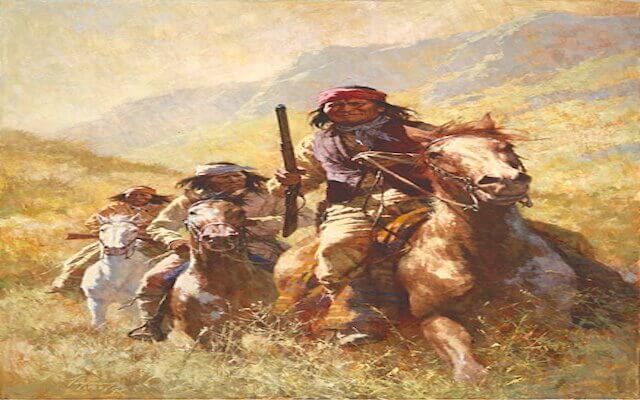
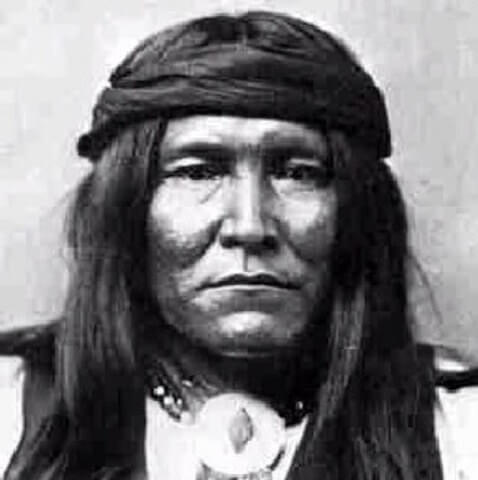

The Apache Indians are divided into six sub-tribes:
Bedonkohe....Be-don-ko-he
Chieahen....Chi-e-a-hen
Chihenne....Chi-hen-ne,(Ojo Caliente),
(Hot Springs)Apaches
Chokonen....Cho-kon-en,
Chiricahua Apache
Nedni....Nendi
White Mountain Apache
Da go Te'....
An Apache Hello
History of the Apache
Apache (probably from Apachu, 'enemy,' the Zuni name for the Navaho, who were designated "Apaches de Nabaju" by the early Spaniards in New Mexico). A number of tribes forming the most southerly group of the Athapascan family. The name has been applied also to some unrelated Yuman tribes, as the Apache Mohave (Yavapai) and Apache Yuma.
Being a nomadic people, the Apache practiced agriculture only to a limited extent before their permanent establishment on reservations. They subsisted chiefly on the products of the chase and on roots (especially that of the maguey) and berries. Although fish and bear were found in abundance in their country they were not eaten, being tabued as food. They had few arts, but the women attained high skill in making baskets. Their dwellings were shelters of brush, which were easily erected by the women and were well adapted to their arid environment and constant shifting. In physical appearance the Apache vary greatly, but are rather above the medium height. They are good talkers, are not readily deceived, and are honest in protecting property placed in their care, although they formerly obtained their chief support from plunder seized in their forays.
No group of tribes has caused greater
confusion to writers, from the fact that the popular
navies of the tribes are derived from some local or
temporary habitat, owing to their shifting propensities,
or were given by the Spaniards on ac count of some tribal
characteristic; hence some of the common names of
apparently different Apache tribes or bands are
synonymous, or practically so; again, as employed by some
writers, a name may include much
more or much less than when employed by others.
The Apache are divided into a number of
tribal groups which have been so differently
named and defined that it is sometimes difficult to
determine to which branch writers refer.
The most commonly accepted divisions are the
Querechos or Vaqueros,
consisting of the Mescaleros, Jicarillas, Faraones,
Llaneros, and probably the Lipan; the Chiricahua;
the Pinalenos; the Coyoteros, comprising the White
Mountain and Pinal divisions; the Arivaipa;
the Gila Apache, including the Gilenos, Mimbrenos, and
Mogollones; and the Tontos.
The word "Apache" comes from the Yuma word for "fighting-men". It also comes from a Zuni word meaning "enemy". The Zuni name for Navajo was called "Apachis de Nabaju" by the earliest Spaniards exploring New Mexico. Their name for themselves is N'de, Inde or Tinde ("the people"). The Apaches are well-known for their superior skills in warfare strategy and inexhaustible endurance. Continuous wars among other tribes and invaders from Mexico followed the Apaches' growing reputation of warlike character. When they confronted Coronado in 1540, they lived in eastern New Mexico, and reached Arizona in the 1600s. The Apache are described as a gentle people; faithful in their friendship.
They belong to the Southern Athapascan
linguistic family. The Apache are composed of six regional
groups: the Western Apache, Chiricahua, Mescalero,
Jicarilla, Lipan,
and Kiowa Apache. On marriage, men customarily take up
residence with their wives' kin. Maternal clans exist
among the Western Apache, who depend more on cultivation
than did other groups. All Apache rely primarily on
hunting of wild game and gathering of cactus fruits and
other wild plant foods. The Western Apache (Coyotero)
traditionally occupy most of eastern Arizona and include
the White Mountain, Cibuecue, San Carlos, and Northern and
Southern Tonto bands. The Chiricahua occupy southwestern
New Mexico, southeastern Arizona, and adjacent Mexican
states of Chihuahua and Sonora. The Mescalero (Faraon)
live east of the Rio Grande in southern New Mexico, with
the Pecos River as their eastern border. The Jicarilla
(Tinde) range over southeastern Colorado, northern New
Mexico, and northwest Texas, with the Lipan
occupying territory directly to the east of the Jicarilla.
The Kiowa Apache (Gataka), long associated with the KIOWA,
a Plains people, range over the southern plains of
Colorado, Oklahoma, and Texas.
Arivaipa Apache
Chiricahua
Apache
Faraon Apache
Gila Apache
Jicarilla
Apache
Lipan
Apache
Mescalero
Apache
Pinal Coyotero
Tonto Apache
Yachin
Yagoyekaydn
Yavapai
Apache
White Mountain Apache Clans
Akonye
Chilchadilkloge
Chiltneyadnaye
Destchin
Gontiel
Indelchidnti
Inoschuhochen
Iyaaye
Kaihatin
Kaynaguntl
Kiyahani
Klokadakaydn
Mayndeshkish
Natatladiltin
Natootzuzn
Peiltzun
Satchin
Tizsessenaye
Tseskadin
Tuakay
Tudisishn
Tushtun
Tutonashkisd
Tutzone
Tzaedelkay
Tzebinaste
Tzecheschinne
Tzetseskadn
Tzintzilchutzikadn
Tziseketzillan
Tzlanapah
Tzolgan
The Apache attained their greatest fame as guerrilla fighters defending their mountainous homelands under the Chiricahua leaders Cochise, Geronimo, Mangas Coloradus, Victorio, and Juh. Today the Apache occupy reservations in New Mexico and Arizona, with some Chiricahua, Lipan, and Kiowa Apache in Oklahoma. In 1680 the Apache population was estimated at 5,000; in 1989 it was estimated at about 30,000, of whom most live on reservations. While accommodating to changed economic conditions, the Apache on reservations have maintained much of their traditional social and ritual activities. Their invincible spirit is still shown today by an energy and fire that makes them a strong and hardy people in modern day society.
The Jicarilla are part of the Apache people. The name Jicarilla means "little basket," deriving from the expertise of their women in making baskets of all sizes, shapes, and colors. Within recent times, they make their homes in southeastern Colorado and northern New Mexico, though a few groups went to Kansas, Oklahoma, and Texas. Originally they came from northwestern Canada among the migration of Athapascan language tribes, then along the eastern flank of the Rocky Mountains. When first met by explorers in the 1540s, they were called the Vaqueros by the Spanish. Though the Spanish established a mission for Jicarillas in 1733 near Taos, New Mexico, it did not succeed. Later, in 1880, the government set aside a reservation for the Jicarillas in the Tierra Amarilla region of New Mexico. Today they live on their reservations in Arizona and in Rio Arriba and Sandoval Counties, New Mexico.
Apaches have always been inherently aware of earth and sky spirits. From their early morning prayers to the Sun-God, through their hours, days, and their entire lives--for them every act has sacred significance.
Stories
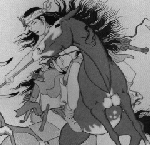
Naiyenesgani went around looking in vain for monsters.
When he failed to find any he started off in this
direction, toward the Mescalero country.
He climbed to the top of White Mountain and looked about
in all the different directions in vain.
There were no monsters. Then he threw away his staff.
"You will get your living by means of this," he said,
and
right where he threw it, it became a yucca.
Then he washed from his hands the pollution from the
killing of the monsters
and threw it in different directions. "With this you
will live," he said, referring to the Mexicans.
That is why sheep and cattle have a bad odor.
The dirt he washed from his hands became cattle and
sheep.
All the monsters were gone. The Mescalero live upon the
staff which he threw away,
the Mexicans live upon the cattle and the sheep.
That is why Mexicans have many sheep and cattle. He
spoke to them this way.
Other Stories
An Apache
Medicine Dance
Apache Creation Story
Apache Fox Stories
Apache
Creation
Stories
Apache Creation Story
Apache
Creation
Story
1
Apache Men
Apache
Meets
a Texan
Apache Women
Arrows
Fail on the Hunt
Captive
Woman Attempts to Make Peace
Deer
Hunt
Duel
Between Scouts
Fight
With the Enemy on the Arkansas River
Horses
of the Apache Are Stolen by the Navajo
Horses
of
the Ollero are Stolen
Hunting
Elk
Leader
of the Birds
Pesita
Is Shot
Successful
Hunt
Turkey Makes The
Corn And Coyote Plants It
Ute
is Saved by his War-Medicine
War
with the Americans
Myths
Bear-Man
Beaver
and
the Old Man
Coyote
Secures
Fire
Coyote
Secures
Fire. (Second Version)
Culture
Heroes
and Owl
Emergence
Fight
With The Enemy On The Arkansas River
First
War
How the Buffalo Were Released
on Earth
Killer-of-Enemies
at
Taos and His Departure
Killing
of the Bear
Killing
of the Monsters.
Naiyenesgani
Rescues
the Taos Indians
Man
Who Helped the Eagles
Man
Who Traveled With the Buffalo
Monster
Fish
Monster
Fish
(Second Version)
Naiyenesgani
Removes
Certain Dangers
Naiyenesgani
Takes
His Leave
Naiyenesgani
Takes
His Leave (Second Version)
Releasing
the
Buffalo
Releasing
the
Buffalo. (Second Version)
Origin
of Corn and Deer
Origin
of Corn and Deer (Second Version)
Origin
of Sheep and Cattle
Slaying
of
The Monsters
Supernatural
Person
in the Lake
Swallowing
Monster
Traveling
Rock
Winning
of Daylight
More Stories
Chiricahua Texts
A
Girl Is Lost
A
Prayer Addressed to the Mountain Spirits
A
Visit to the Mountain Spirits
Coyote
and
the Money Tree
Coyote
and
the Rock Rabbit
Coyote
and
the Rolling Rock
Coyote
Holds
Up the Sky
Coyote
Misses
Real Rabbit
Coyote
Obtains
Fire
Why
the
Bat has Short Legs
Jicarilla
Apache Coyote Stories
The coyote cycle is a series of tales or
episodes involving the travels and adventures of
the trickster,
Coyote.
For any one story-teller, these tales or
episodes had a fixed order in respect to one
another,
though another story-teller's account might run
somewhat differently.
The manner of organizing these episodes seemed
to depend more or less on family lines,
since the young of a given family group drew
their inspiration from some venerable
relative and carried on his version of the
proper way to relate the antics of Coyote.
Coyote
and
Beaver
Coyote
and Beaver Exchange Wives
Coyote
and Beaver Play Tricks On Each Other
Coyote
and
Bobcat Scratch Each Other
Coyote
and
His Mother-in-Law
Coyote
and Porcupine Contend For a Buffalo
Coyote
and the Mexicans
Coyote
and
the Two Running Rocks
Coyote
Apes His Hosts
Coyote
As Eye-Juggler
Coyote
Burns
His Children
Coyote
Comes
to Life Four Times
Coyote
Dances
with the Prairie Dogs
Coyote
Deceives
a Woman
Coyote
Gets
Rich Off The White Men
Coyote
Insults
The Rock
Coyote
in
the Underworld;
The Origin of the Monsters;
The First Emergence
Coyote
is
Disobeyed by Turkey
Coyote
is Revenged on Wildcat
Coyote
Kills
His Own Child Instead of the Turkeys
Coyote
Kills
His Wife and Carries Her Body
Coyote
Kills
the Prairie Dogs
Coyote
Loses
His Bow and Arrows to Antelope
Coyote
Loses
His Eyes
Coyote
Marries
His Own Daughter
Coyote
Marries
Under False Pretences
Coyote
Obtains
Fire
Coyote
Plays
Tricks on Owl; the Vomit Exchange
Coyote
Proves Himself a Cannibal
Coyote
Secures
Fire
Coyote
Secures
Fire II
Coyote
Steals a Man's Wife
Coyote
Steals
Another Man's Wife
Coyote
Takes
Arrows From Owl
Coyote
Tries
to Make His Children Spotted
Coyote
Visits
Buffalo
Coyote
Visits
the Red Ants
Race
around
the World
Rabbit Escapes
Rabbit
Fools
Coyote
Rabbit
Scares
Coyote Away
Jicarilla Texts
Chiricahua
and Mescalero Apache Texts
An
Apache
Medicine Dance
An
Expedition
To The Adobe Walls With Kit Carson
An
Unsuccessful
Expedition Led By Maxwell
Antelopes
Take
Arrows from Coyote 1
Antelopes
Take
Arrows from Coyote 2
Apache Medicine Dance
Ceremony
For
Buffalo
Death
of
the Great Elk
Destruction
of
the Bear
Fox
and
Deer
Fox
and
Kingfisher
Fox
and
Mountain Lion
Fox
and
Porcupine
Fox
and
Rabbit
Fox
and
Wildcat
Jicarilla
Genesis
Legend
of
the Apache Tear
Old
Beggar
Origin
Of
Corn
Origin
Of
Curing Ceremonies
Origin of Fire
Origin of the Animals
Two
Blind
Old Women
Why
the
Bat Hangs Upside Down
Myths and tales of the Jicarilla Apache
Mescalero Texts
Coyote
and Beaver
Coyote
and
Blue Bunting
Coyote
and
Owl
Coyote
and
Quail
Coyote
and
the Creation
Coyote
and
Turtle
Dahteste
- (pronounced
ta-DOT-say)
Deer
Hunting
in the Mescalero Country
Mescalero
Beg
For Meat
White
Mountain Apache
Abandoned
Children
Badger Carries Darkness:
Big
Owl
Chops off His Manhood
Coyote
and
Bobcat Scratch Each Other
Coyote
Gets
Rich Off The White Men
Coyote
proves
himself a Cannibal
Coyote
Reads the Letter As He Sits
Coyote
Steals Abert Squirrel's Fire
Coyote
Steals
Sun's Tobacco
Coyote
Steals
Wheat
Coyote
Trots Along
Coyote's
Daughter [Becomes] His Wife
Gray
Fox Steals Wheat: Coyote's Feces Under
His Hat
Ga-n
Becomes Raven Old Man's Son-In-Law
Grasshopper
loses His Leg
He
Goes To His Father Slaying Of Monsters
Her
Brother Becomes Her Husband
Yavapai
Coyote
fights
a lump of pitch
Coyote
Steals
a Man's Wife
Coyote
Takes
Arrows From Owl
Antelopes
Take
Arrows From Coyote
Antelopes
Take
Arrows From Coyote. (Second
Version.)
Coyote
Tries
to Make His Children Spotted
Coyote
Kills
His Own Child Instead of the Turkeys
Coyote
and Porcupine Contend For a Buffalo
Coyote Loses His Eyes
Coyote
Kills
the Prairie Dogs
Coyote
is Revenged on Wildcat
Coyote
and Beaver Play Tricks On Each Other
Coyote
Apes His Hosts
Coyote is Disobeyed by Turkey
Coyote
is Shot With a Pine Tree
Coyote
Insults
the Rock
Coyote
Marries
Under False Pretences
Mosquito
Marries
Under False Pretences
Coyote
Deceives
a Woman
Coyote
and the Mexicans
How Mole Won the Race
Frog Wins From Antelope in a
Footrace
When
the Birds Were Chiefs
Woodpecker
Describes
Himself
Flicker Describes Himself
Lewis
Woodpecker
Describes Himself
Owl
Describes
Himself
Panther,
the
Great Hunter
The
Governor,
Old Woman White Hands
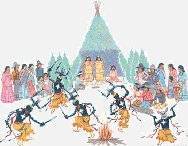
The Mescalero
Apaches, descendants of
Geronimo and his warriors,
perform the Crown
Dance, (video)
also known as the Mountain
Spirit
Dance, around the 4th of
July.
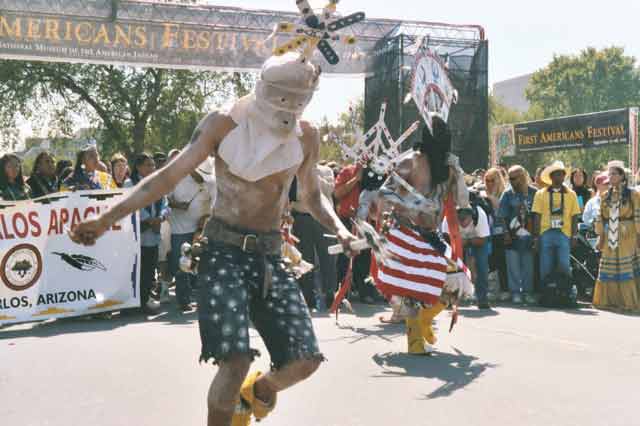
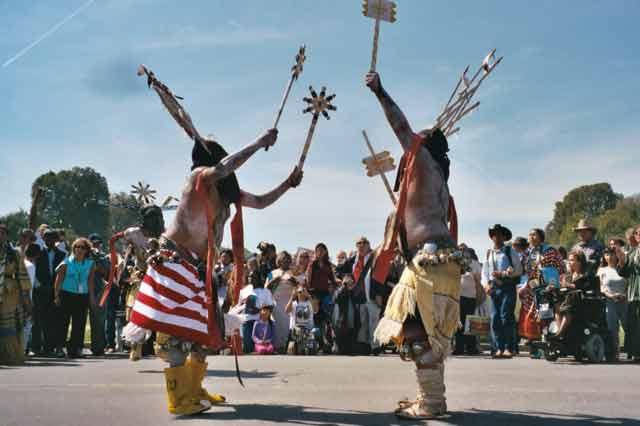
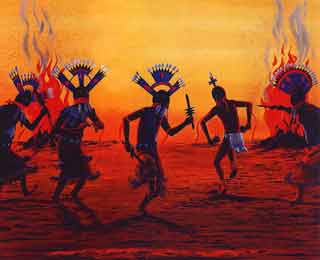
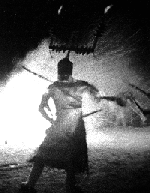
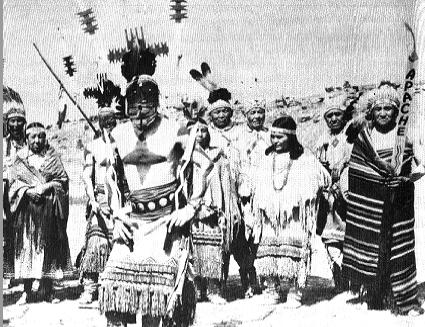
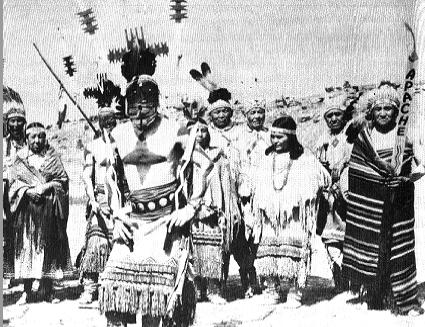
They carry painted yucca swords, with lightening bolts emitting from them and give out loud Hoot Owl cries. the headdresses give rise to the anglo name for the dance, looking much like a large ornate crown. They dance to ward off evil and disease causing spirits from the people and the lands they live on, which are the beautifully pine forested Sacramento mountains of South Central New Mexico.
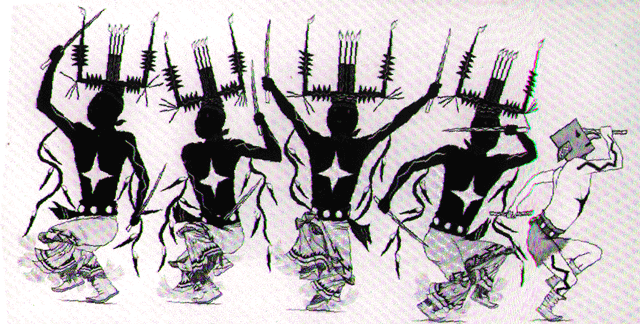
THE SLAYING OF THE MONSTERS
(An Apache Legend)
Apache mythology describes the adventures of ancient gods, humans and animals to help describe the Creation of the World, and how it operates. Although each Apache tribe has it’s own unique stories, three cultural heroes are common to all Apache mythology: White-painted Woman, Killer of Enemies and Child of the Water. One myth explains how, long ago, Child of the Water made the earth safe by killing four (4) monsters who preyed on human beings. In the beginning, White-painted Woman and Killer of Enemies, who was either her brother or son, lived together on the earth. They were tormented by cruel monsters, especially by Owl-man Giant, who stole the deer meat shot with bow and arrow by Killer of Enemies. One day, when White-painted Woman was praying for the monsters to leave them alone, the spirit known as Life Giver came to her in the form of rain and lightning. Life Giver told her she would have a child, who would be called Child of the Water. Life Giver warned White-painted-Woman that she must protect the child from Owl-man Giant. Through her skill and cunning, White-painted Woman kept the child safe.
One day, while he was still a boy, Child of the Water told his mother that he was ready to leave her to kill the monsters. White-painted Woman fashioned him a wooden bow and grama-grass arrows. She let him venture out to hunt deer with trusted Killer of Enemies. After they had killed their first deer, Owl-man Giant came to steal the meat away. But, Child of the Water refused to give it up! The opponents agreed to a duel. Each would be allowed to shoot four arrows. Owl-man Giant was to shoot first. But before he began, magical lightning flashed all around them. A brilliant blue rock appeared at the feet of Child of the Water. The blue rock spoke, saying that Child of the Water should pick it up, and use it as a protective charm. Child of the Water did and waited for Owl-man Giant to shoot his four dangerous arrows. They were made of sharp, large pointed logs.
The first arrow flew over Child of the Water’s head. The second landed at his feet. The third and fourth arrow missed him on each side. He was still ALIVE! Now, it was Child of the Waters turn! Owl-man Giant wore four coats of flintstone to protect his chest. He also picked up a rock, to try to deflect the arrows, like Child of the Water had done. But, the first three arrows that Child of the Water shot, knocked off the coat of protective flint. The fourth, and fatal, arrow pierced Owl-man Giant’s evil heart. The child warrior was victorious! Killer of Enemies and Child of the Water returned victoriously to White-painted Woman, who danced and sang with happiness. Child of the Water went out again on further hunts. He killed the Buffalo Monster. Then, the Eagle Monster. And, finally, the Antelope Monster. The earth was now SAFE! The human population began to grow and prosper. Thus, the Apache regard Child of the Water, with his blue stone (turquoise), as their divine ancestor.
Other Apache Home Pages
Apache
Stories
Apache
Tears
Ebarb
Choctaw-Apache Tribe
Indians
of Texas
Letters
on
the Texas Missions
Na-Dene
The
Children of Changing Woman
Apache
Photo
Album
Homage
to
Mildred I. Cleghorn
Geronimo's Song
Lipan
Apache
Lipan-Karankawas
Park
Lipan
Lands
Bee County, Texas
Apache
Indians
- Texas History
Lipan
Apache Lands
My
Apache Heritage
Lipan
Apache Historical & Academic
References
References
Chiricahua and Mescalero
"A Chiricahua Apache account of the
Geronimo Campaign of 1886",
Morris Opler, New Mexico Historical
Review October, 1938, Vol. XIII, No. 4.
Narrated by Samuel E. Kenoi.
"Myths of the Jicarilla Apaches",
Frank Russell,
The Journal of American Folklore Vol
XI, No. XLIII, 1898, pp. 253-271.
Narrated by Laforia, translated by
Gunsi.
"The Jicarilla Genesis", James Mooney,
American Anthropologist Vol. XI,
No. 7, 1898, pp. 197-209. Translated
by Tsisti,
whose English name is "Ed. Ladd" and
narrated by his father.
"An Apache Medicine Dance", Frank
Russell, American Anthropologist Vol.
XI,
No. 12, 1898, pp. 357-372. Based on
description of the ceremony provided
by Gunsi.
 Return to
Indigenous Peoples' Literature
Return to
Indigenous Peoples' Literature
Compiled by: Glenn
Welker
ghwelker@gmx.com
This site has been accessed 10,000,000 times since February 8, 1996.