GUOXIE DANCE

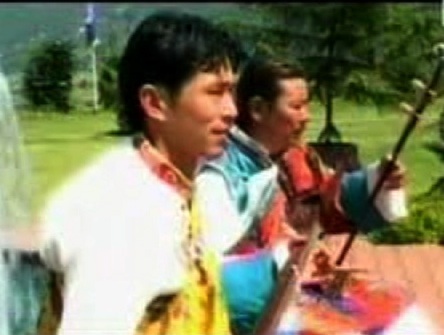
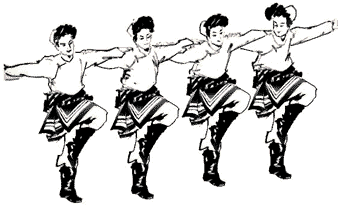
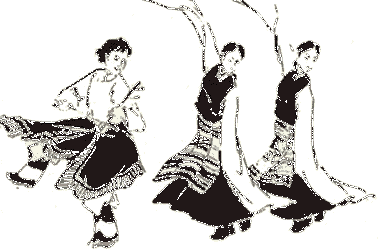
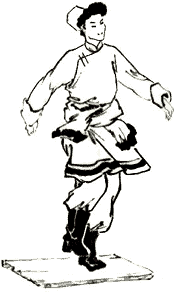
Guoxie (meaning "village" in Tibetan) is a group dance popular in rural areas of Tibet. The participants dance hand in hand and sing in rotation. The dance is often seen in villages, on open squares and threshing grounds. At festivals people dance and sing from sunset to sunrise. They mark the rhythm by stamping their feet.

Guoxie is performed to a 2/4 beat with the stress on the first beat. The steps are steady and vigorous, characterized by a marked tempo and a strong sense of people's labour and life. The underlying characteristic of the dance is the expression of collective enthusiasm and joy. This dance is found everywhere in Tibet, but the most renowned version is found in the Shannan area. The form is largely as follows:

At festivals men and women stand hand in hand in two lines around a big vat of highland-barley wine placed on open ground. The two groups first sing and walk from left to right in a circle. When they finish singing, the xieben, or organizer of the dance, leads in shouting, "Xiu, xiu, xiu, xiu," and starts the dance with rhythmic steps. This rhythmic shouting is called xiege in Tibetan, or "beginning of the song," which is followed closely by quick-tempo singing and dancing. The two lines of men and women compete in their dancing. After repeated dancing the xieben leads in shouting, "Xiu, xiu, xiu, xiu," or sings alone while the others dance to his tempo. This part of the dance is called xiexiu, or finale.

Xiege thus is both the beginning of the song and the initial dance steps to shouts of "Xiu, xiu, xiu, xiu," or "Ci, ci, ci, ci." The dancers' shouts are very similar to "One, two, three-- everybody dance!" As many people participate in Guoxie and it usually does not have any instrumental accompaniment, it is hard to attain uniform dance movements. Xiege is designed to arouse people's enthusiasm and get them moving together. Xiexiu, the finale, is usually the climax of the dance. Xiege sparks the participants' enthusiasm in their concluding climatic dance steps. A solo popular in the Shannan area goes, "Ah, jia, hei! Nowhere else on earth can match our beautiful homeland. No house is as comfortable as my house. No other young people are as happy as we are, and no other people are as lucky as we are." The people dance during the solo, then shout in chorus, "Xiu, xiu, xiu, xiu," to conclude the dance.


Compiled by: Glenn Welker


Return to Chinese Literature