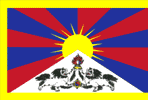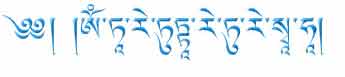


Tibetan Literature
Tibetan
is spoken by about 5 million people in Tibet. Tibet has
3 parts - Central Tibet U-Tsang, Northern Amdo and
Eastern Kham. Nowadays Tibet is has been separated and
renamed as: Tibetan autonomous region, Qinghai province,
in the south of Gansu province, and west of Sichuan
province and north of Yunnan province. Tibetan refugees
all around the world speak Tibetan - in Nepal, Northern
India, Switzerland, the Americas, etc.
Of the major languages of Asia, Tibetan has the most in
common with Burmese. The two languages belong to the
same branch of the Sino-Tibetan family. The Tibetan
alphabet dates from the 7th century A.D. It is based on
the Sanskrit, having been adapted by a Tibetan minister
sent to study Sanskrit in Kashmir.
Tibetan
is an ancient nationality. According to historical
records the ancestors of the Tibetans gathered along the
banks of the middle reach of the Brahmaputra. Due to the
vast grasslands and lush pastures, sheep, goat and yak
were easily fed and stock breeding gradually became
their main economic support. They also engaged in
agriculture and highland barley, a grain that is the
material of tsampa and ghee. Wheat, peas and canola are
also planted. Tsampa, mutton and beef are the staple
food of Tibetans. In some areas, rice and noodles are
also a regular part of the diet. Tea with butter or
milk, sour milk and cheese are the favorites of all
Tibetans.
Tibetans
have their own language and letters. The wide use of
Tibetan language promotes the economic and cultural
exchange between the Tibetan and their neighbors.
Tibetans also have their own calendar. The exact date
for the new year changes every year but its mostly
around the months of February and March. The Tibetan New
Year for 2004 was on February 21st. The period from the
10th century to 16th century was the golden age of
Tibetan culture. Tibetan art has a dual character: on
the one hand, it seems related to Indian art, with its
artistic patterns and stress on deep red, blue and
green; on the other, it is distinctively Tibetan,
different from both the East and the West.
Herders of yaks, sheep, and
goats and farmers of barley, peas, and tubers, the
Tibetans sparsely inhabit a high, desolate region
surrounded by mountains and barricaded on the east by
the canyons of the Yangzi, Mekong, and Salween Rivers.
Monba people are Tibetan people living in the
Himalayas.
 Return to Indigenous Peoples' Literature
Compiled by: Glenn
Welker
ghwelker@gmx.com
This site has been accessed 10,000,000 times since February 8, 1996.