
The Ainu
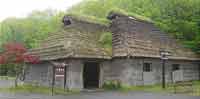
Ainu House
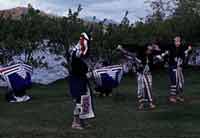
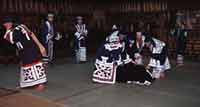
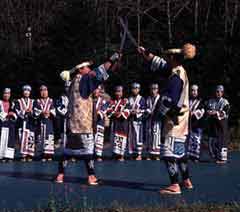
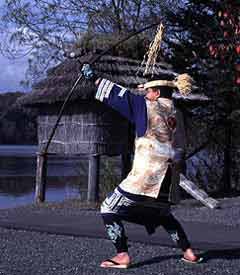
The Shiraoi Ainu Museum, also called Porotokotan, is one of Hokkaido's better Ainu Museums. Ainu culture and lifestyle is shown in an outdoor reproduction of a small Ainu village and inside a conventional museum building. Several performances, such as traditional Ainu dances, are held throughout the day.
In 1997, a new law was passed which provides funds for the research and promotion of Ainu culture.

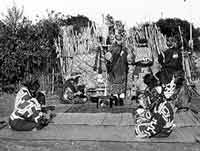
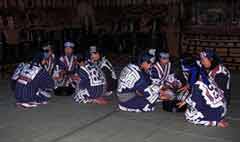
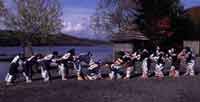
Sacred Dances
 |
 |
|
|
"upopo"
|
||
beating the lid of a container called "shintoko."
The words are not long and are sung repeatedly in a round or a chorus.
|
|
|
Scholars have advocated various theories about
the origin of the Ainu people. The theories include the
Caucasoid (Caucasian) Theory, the Mongoloid Theory, the
Oceania Race Theory, the Old Asian Race Theory, and the
Solitary Race Theory. Some scholars have recently advocated
the following hypothesis into which the Mongoloid Theory has
developed. Mongoloid peoples once were of two types :
Southern Mongoloid and Northern Mongoloid. Before the Jomon
Period (several tens of thousands of years ago), the
Southern Mongoloid started moving northward and settled the
Japanese archipelago, including Okinawa, over a long period
of time. Later, the Southern Mongoloid played a major role
in the Jomon Period throughout Japan. However, in the Yayoi
and Tumulus Periods, the Northern Mongoloid came across the
sea to Japan in great numbers. The ethnic Japanese
(non-Ainu) are the people who have evolved rapidly through
the strong influences of these migratory processes. On the
other hand, the Ainu in Hokkaido and the Tohoku region and
the Ryukyu people in Okinawa are the ones who have hardly
affected by this process.
THE RELATIONSHIP BETWEEN BASQUE AND AINU
The language of the Ainu bear-worshippers of Northern Japan
has generally been considered a language-isolate, supposedly
being unlike any other language on earth. A few researchers
noticed a relationship with languages in south-east Asia,
others saw similarity with the Ostiak and Uralic languages
of northern Siberia. The Ainu look like Caucasian people,
they have white skin, their hair is wavy and thick, their
heads are mesocephalic (round) and a few have grey or blue
eyes. However, their blood types are more like the Mongolian
people, possibly through many millennia of intermixing. The
Ainu are a semi-nomadic hunting and fishing tribe but also
practice simple planting methods, which knowledge may have
been acquired from the newcomers. The invading people, under
their Yamato government, called them the Ezo, the unwanted,
and forced the Ainu in fierce fighting to retreat north to
the island of Hokkaido. The name Ezo likely is an
abbreviation of the Basque word ezonartu (to disapprove of)
The Ainu are a people with a cultural and racial background
which is different from that of the ethnic Japanese. They
have been populating Hokkaido, northern Tohoku, the Kurile
Islands and Sakhalin, but today only a small population
remains mainly in Hokkaido.
According to one of several theories, the Ainu are
descendants of Mongoloid migrants who entered the Japanese
islands before the Jomon period. They were later displaced
and assimilated,
when the ethnic Japanese expanded their territory
northernwards.
The Ainu people originally did not have an
alphabet. Therefore, they have orally transmitted literature
such as tales, legends, experiences, and morals for everyday
life from generation to generation.
" Yukar" are the tales of heroes. They are also called
"yayerap," "sakorpe," or "haw" in some areas. Yukar are
called "hawki" in Sakhalin. The hero is an orphan boy called
by various names, including "Poiyaunpe,"
"Pon-shinutapkaunkur," "Pon-otasamunkur," and " Yayresupo,"
depending on the area. The narrator of yukar sits at the
fireside and recites the adventure stories of this boy all
night, beating the fireside with a stick called "repni. "
In some stories, the heroes are men ; in others, they are
gods whose appearance resembles men. In a story in which
heroes are gods, gods with such names as "Aeoynakamuy,"
"Ainurakkur" and "Okikurmi" descend from the heavens to the
human world and experience various dramatic events with man.
In the lburi and Hidaka districts, such stories are called
"oyna." However, in other areas, such stories are included
in " kamuy yukar" as described below.
The Ainu people originally did not have an
alphabet. Therefore, they have orally transmitted
literature such as tales, Iegends, experiences, and morals
for everyday life from generation to generation.
" Yukar" are the tales of heroes. They are also called
"yayerap," "sakorpe," or "haw" in some areas. Yukar are
called "hawki" in Sakhalin. The hero is an orphan boy
called by various names, including "Poiyaunpe,"
"Pon-shinutapkaunkur," "Pon-otasamunkur," and "
Yayresupo," depending on the area. The narrator of yukar
sits at the fireside and recites the adventure stories of
this boy all night, beating the fireside with a stick
called "repni. "
In some stories, the heroes are men ; in others, they are
gods whose appearance resembles men. In a story in which
heroes are gods, gods with such names as "Aeoynakamuy,"
"Ainurakkur" and "Okikurmi" descend from the heavens to
the human world and experience various dramatic events
with man. In the lburi and Hidaka districts, such stories
are called "oyna." However, in other areas, such stories
are included in " kamuy yukar" as described below.
Stories in which heroes are "natural" gods
such as animal ones are called "kamuy yukar. " The
narrator recites animal gods' experiences with morals,
repeatedly inserting words called "sakehe " between
phrases.
The oral literature of the Ainu is not only "recitative"
as described above, but also "narrative uepeker " which is
usually translated as, "an old tale," is called "tuitak"
in some areas and "uchashkuma" in Sakhalin. Although
uepeker is translated as an old tale, it is not a
fictitious one but a real one with experiences of those
who lived in olden times. Tales called "ikopepka" or
"upashkuma" more closely resemble legends than do those
called "old tale."
" Yaysama" is oral literature in which a woman sings an
impromptu song of her emotions. Most words have been
handed down from generation to generation. This is why it
can be said to belong to oral literature.
Books
Ainu: Spirit of a Northern People

 Return to Indigenous Peoples'
Literature
Return to Indigenous Peoples'
Literature
Compiled by: Glenn Welker