Hawaiían (Kanaka Maoli) Literature
Hawaii's history
in story and legend is ancient and proud, dating back at least a thousand
years before American colonies became a nation in 1776. It is highly unlikely
that the exact date when Polynesian people first set foot on these previously
uninhabited islands will ever be known, nor much details about events
occurring between that date and the first contact with Europeans. The
Hawaiians were a people without writing, who preserved their history in
chants and legends. Much of the early history has disappeared with the
death of the kahunas and other learned men whose function it was to pass
on this knowledge, by means of chants and legends, to succeeding generations.
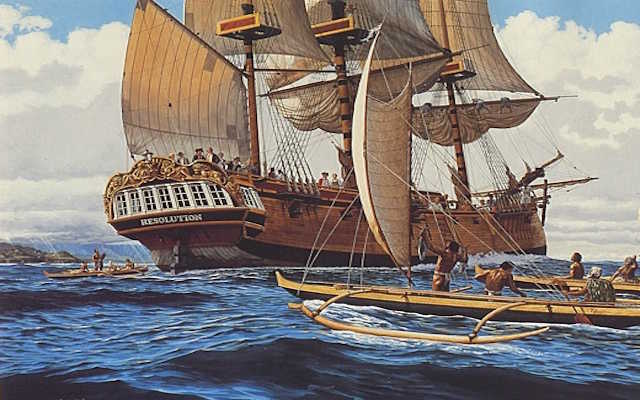
Modern Hawaiian history begins on January 20, 1778, when Captain James
Cook's expedition made its first contact with the Hawaiian people
on the islands of Kauai and Niihau. Captain Cook was not the first man
to "discover" the Hawaiian Islands. He was the first known European
to arrive.
The language
of Hawaii and archaeological discoveries indicate that Hawaii was
settled by two distinct waves of Polynesian migration. Cook himself knew
that the original Polynesian discoverers had come from the South Pacific
hundreds of years before his time. First, from the Marquesas, came a settlement
as early as 600 or 700 AD, and then from the Society Islands, another
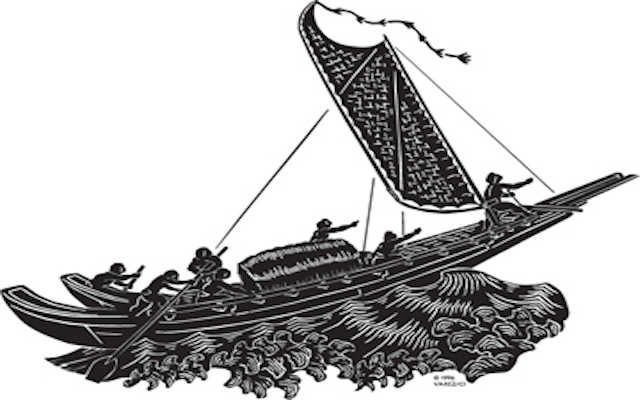
migration about 1100 AD. Lacking instruments of navigation or charts or
any kind, the Polynesians sailed into vast oceans. They staked their knowledge
of the sky and its stars, the sea and its currents, the flight of birds
and many other natural signs. They were superior seamen of their time.The
Hawaiian language word Hawaiʻi derives from Proto-Polynesian *Sawaiki,
with the reconstructed meaning "homeland"; cognate words are
found in other Polynesian languages, including Māori (Hawaiki), Rarotongan
(ʻAvaiki), and Samoan (Savaiʻi).
The Kapu
System separated Hawaiian society into four groups of people:
1) the alii, chiefs who ruled specific territories and who held their
positions on the basis of family ties and leadership abilities - the chiefs
were thought to be descendants of the gods and the highest chiefs, alii
kapu, were considered gods; 2) the kahuna, priests or skilled craftspersons
that performed important religious ceremonies and served the alii as close
advisers; 3) the makaainana, commoners (by far the largest group) who
raised, stored, and prepared food, built houses and canoes, and performed
other daily tasks; and 4) the kauwa, outcasts forced to lead lives segregated
from the rest of Hawaiian society.